Subterranean termite barrier treatments establish an undetectable, continuous liquid perimeter directly against the foundation walls of a residential structure. In Pulaski County, high native populations of Eastern…
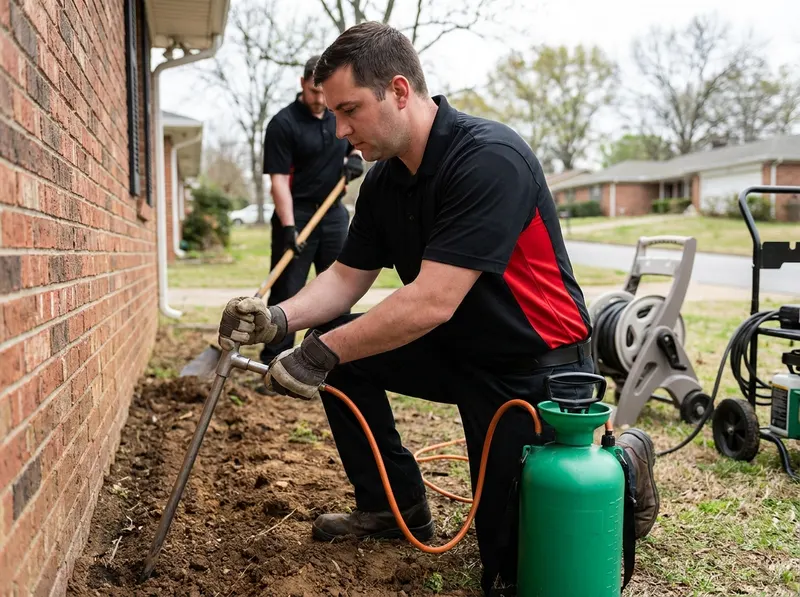
Subterranean termite barrier treatments establish an undetectable, continuous liquid perimeter directly against the foundation walls of a residential structure. In Pulaski County, high native populations of Eastern subterranean termites live underground in colony networks containing hundreds of thousands of individual workers. Older pier-and-beam homes in Hillcrest, Stifft Station, and The Heights frequently have direct wood-to-soil contacts and damp crawlspaces that encourage vertical shelter tube construction. For these properties, trenching is dug 6 inches wide and 6 inches deep around every load-bearing perimeter wall and interior brick pier, saturated with a non-repellent termiticide at a standard rate of 4 gallons per 10 linear feet per foot of depth down to the top of the footing.
Slab-on-grade homes common throughout Chenal Valley, Rock Creek, and Midtown present different entry vectors, primarily settling cracks, cold joints where garages meet living spaces, and plumbing penetration cutouts under bathtubs. Treating these entry points requires precision horizontal sub-slab rod injection. Technicians drill 1/2-inch holes spaced roughly 12 inches apart through exterior concrete flatwork or interior stress joints to introduce the liquid barrier directly into the soil beneath the slab, eliminating blind spots where exploratory workers track unseen moisture sources.
A non-repellent liquid soil barrier provides immediate structural interruption compared to perimeter bait stations. In situations where active mud tubes or swarmers emerge inside baseboards in Capitol View or Broadmoor, the priority is stopping ongoing structural consumption immediately. While monitoring stations rely on slow foraging over several months to recruit workers, non-repellent liquid termiticides exploit social grooming biology: worker termites pass undetected through treated soil, pick up the active chemical, and distribute it through trophallaxis to the queen and secondary reproductives, terminating the colony from the outside. The trade-off is mechanical site disturbance: barrier application requires continuous soil trenching around landscaping and selective concrete core drilling around attached driveways and brick patios, whereas bait systems leave hardscapes untouched.
Every job gets a firm, written price after a free on-site visit.
Tell us about your subterranean termite barrier treatment job in Little Rock and we'll send a clear, written quote, usually the same day.
 Brevon Bug Specialists