Brevon Bug SpecialistsBrevon Bug Specialists

Crawl Space & Attic Rodent Exclusion Little Rock

Crawl space & attic rodent exclusion stops recurrent infestations by targeting primary architectural vulnerabilities rather than broadcasting temporary chemical baits. In the historic pier-and-beam foundations of…
Get My Free Estimate →(327) 202-3620
Crawl Space & Attic Rodent Exclusion in Little Rock,
Quick answer
  • Scope: Complete exterior entry point sealing, foundation vent screening, interior trap placement, and contaminated nesting spot sanitation.
  • Turnaround time: Initial physical inspection and barrier installation take 3 to 6 hours, followed by a 7-day snap-trap monitoring cycle.
  • Cost ranges: Standard services range from $350 to $1,800 depending on linear feet of roofline; baseline diagnostic visits start at $150.
  • Materials used: 16-gauge galvanized steel wire hardware cloth, poly-foam backing, steel wool packing, and dual-cure elastomeric caulking.
  • Scheduling: Inspections are confirmed via telephone at (327) 202-3620 with on-site evaluations completed across Pulaski County within 24 to 48 hours.

Crawl space & attic rodent exclusion stops recurrent infestations by targeting primary architectural vulnerabilities rather than broadcasting temporary chemical baits. In the historic pier-and-beam foundations of Hillcrest, Stifft Station, and Capitol View, settling brick piers and shifted crawl space lattice create unmonitored sub-floor access for rodents. Conversely, multi-dormer suburban properties in Chenal Valley and Rock Creek frequently experience roof rat activity entering via soffit returns, ridge vent gaps, and unstopped construction junctions. Standard chemical baiting programs fail to resolve these intrusions permanently because decaying rodents trapped inside drywall cavities release severe odor compounds, while outdoor bait boxes simply draw new populations from nearby wooded drainage basins such as Boyle Park.

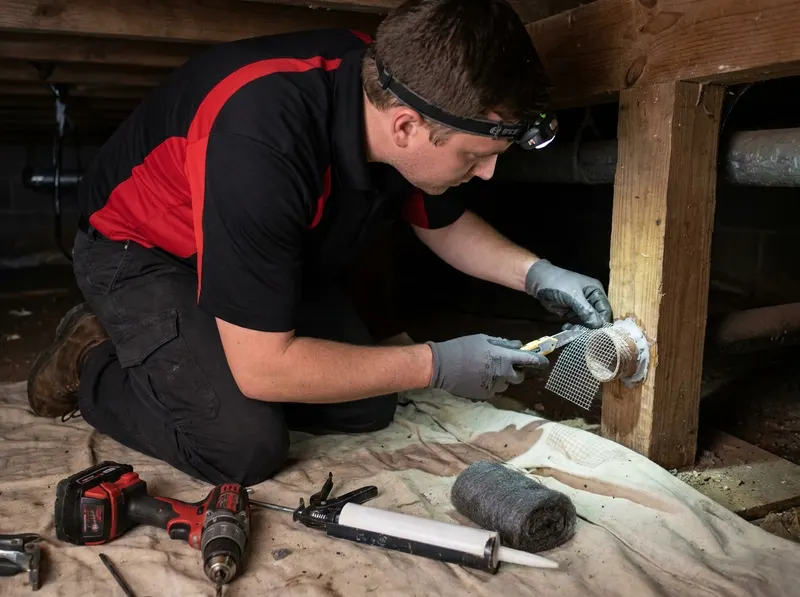
The mechanical exclusion sequence follows a strict three-phase deployment. First, technicians map all active gnaw channels, grease rub marks, and droppings measuring between 1/4 inch and 3/4 inch to calculate entry distribution. Second, teams install 1/4-inch 16-gauge galvanized hardware cloth over foundation vents, mortar voids, and roofline fascia gaps, securing materials with mechanical fasteners rather than adhesive tape. Copper mesh and silicone sealants plug utility lines where HVAC conduit or PEX plumbing lines penetrate exterior sheathing. Third, internal mechanical snap traps clear remaining animals within the envelope over a multi-day cycle, avoiding non-target poisoning risks for household dogs and cats without locking homeowners into indefinite recurring monthly spray subscriptions.

Decision criteria depend on construction age and envelope continuity. If an attic reveals isolated mouse droppings near an open access hatch, mechanical trapping combined with localized door sweep additions resolves the issue at low cost. If an attic contains trampled insulation runs, damaged electrical wire coating, or nesting directly beneath asphalt roof deck joints, full architectural exclusion with perimeter vent flashing is required. The trade-off centers on upfront mechanical labor versus repetitive chemical treatments: physical exclusion carries a higher single-visit installation investment but permanently halts animal ingress without residual pesticide exposure indoors.

Crawl Space & Attic Rodent Exclusion cost in Little Rock

Baseline Diagnostic Evaluation & Trapping Setup$150 to $275
Standard Crawl Space Foundation Sealing (Up to 1,500 sq ft)$450 to $950
Attic Roofline, Fascia & Soffit Exclusion (Standard Pitch)$650 to $1,400
Comprehensive Envelope Exclusion (Dual Attic & Pier-and-Beam)$1,200 to $2,800

Every job gets a firm, written price after a free on-site visit.

Common questions

What causes roof rats to invade attics across Little Rock?
Mature oak and pine canopies in neighborhoods like The Heights and Cammack Village provide aerial pathways directly to gutter lines, allowing rodents to enter through 1/2-inch gaps under fascia boards.
How does exclusion differ from conventional pest control in Little Rock?
Conventional pest control relies on recurring poison bait stations around exterior walls, whereas structural exclusion physically seals every architectural gap using steel barriers to deny entry entirely.
Are the exclusion materials safe for indoor pets in Little Rock homes?
Physical exclusion uses non-toxic mechanical barriers including galvanized steel hardware cloth and expanding elastomeric sealants, eliminating loose chemical rodenticides inside living areas.
Does high humidity around Little Rock affect crawl space exclusion seals?
Technicians install corrosion-resistant 16-gauge galvanized steel mesh that withstands the high crawl space humidity common across Pulaski County without rusting or rotting.
What is the minimum cost for rodent diagnostic work in Little Rock?
The minimum charge for an initial on-site physical inspection and baseline rodent assessment across Little Rock is $150, with total repair costs confirmed after measuring structural entry points.
Helpful resources

Trusted references & local links

USA.gov, government & consumer helpBetter Business BureauFTC Consumer AdviceU.S. Small Business AdministrationReady.govU.S. EPAENERGY STARU.S. Dept. of EnergyConsumer.govU.S. Census BureauGoogle Maps, Little Rock

Get started today

Tell us about your crawl space & attic rodent exclusion job in Little Rock and we'll send a clear, written quote, usually the same day.

Get your free PEST CONTROL SEVICE quote, Little Rock

We only use your ZIP to check availability, no spam.