Red imported fire ants (Solenopsis invicta) thrive in the humid subtropical climate and varied soils of Pulaski County. In neighborhoods like Chenal Valley and Rock Creek, sloped, newly graded turf often conceals…
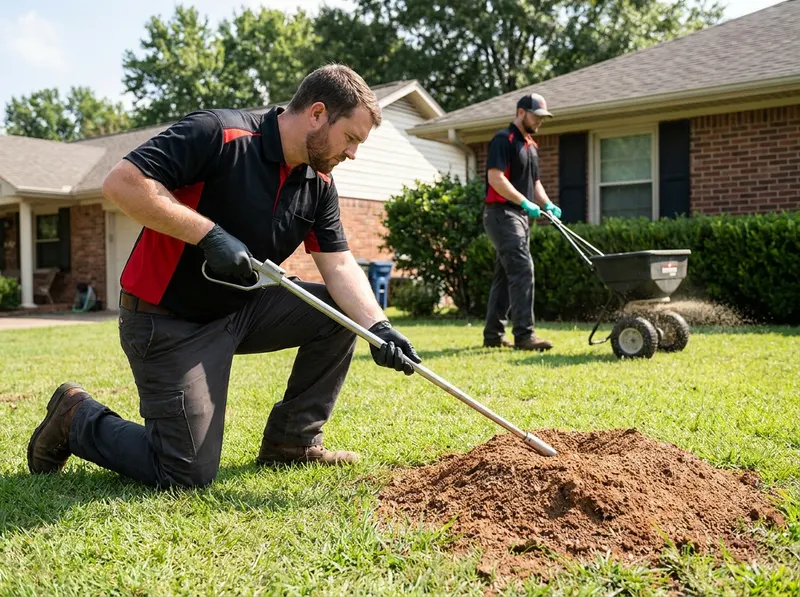
Red imported fire ants (Solenopsis invicta) thrive in the humid subtropical climate and varied soils of Pulaski County. In neighborhoods like Chenal Valley and Rock Creek, sloped, newly graded turf often conceals subterranean tunnel networks, while older established lawns in Hillcrest, The Heights, and Cammack Village present deep root zones where colonies insulate below the frost line. Over-the-counter contact sprays kill surface foragers but cause the queen to relocate deeper underground, splintering single colonies into three or four satellite nests. Professional eradication pairs targeted mound drenches, delivering liquid controls directly into the central brood chambers, with a broad-scale broadcast across turf grass to intercept outdoor foraging trails before workers reach patios or play structures.
Selecting between spot mound drenching and full-property broadcasting depends on colony density and proximity to water or structures. Spot injection suits properties with fewer than three isolated mounds along gravel driveways or isolated landscape edges. When colonies breach manicured turf near Boyle Park or Broadmoor, single-mound treatments leave the underlying lawn vulnerable to re-infestation within weeks. A complete broadcast applies an insect growth regulator (IGR) or metabolic inhibitor bait across the entire yard. The trade-off involves timing: direct mound drenches deactivate aggressive stinging ants in 24 to 48 hours, whereas broadcast baits rely on worker ants carrying active ingredients back to the queen over 7 to 14 days for total colony sterilization.
Properties bordering wooded perimeters, drainage swales, or green spaces in Capitol View, Midtown, and Stifft Station require strict exterior containment. Technicians establish a continuous boundary line around foundations, AC pads, and fence lines to stop inward migration. Once the granular broadcast dries and settles into the thatch layer, typically within two hours of application, the lawn is accessible for pets and children. Ongoing control does not mandate a locked-in monthly contract; most Little Rock properties maintain clear turf through two seasonal applications timed between late spring and early autumn.
Every job gets a firm, written price after a free on-site visit.
Tell us about your fire ant mound eradication & lawn broadcast job in Little Rock and we'll send a clear, written quote, usually the same day.
 Brevon Bug Specialists